

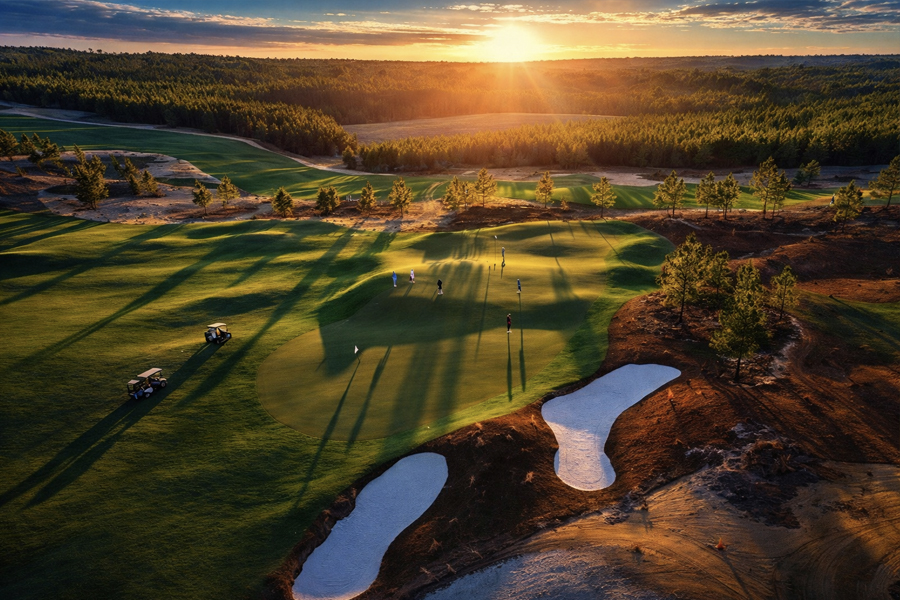
A Modern Interpretation of MacKenzie’s Daring Design
SOUTH CAROLINA SANDHILLS: Outside Aiken, South Carolina—just across the river from Augusta—21 Golf Club is taking shape for a very specific tribe: golf geeks and aficionados who care about architecture, playing great matches with friends, and the kind of strategic golf that keeps you thinking long after the round is over. In spirit, it’s a modern Southern gentlemen’s club—built around the walk, the conversation, and the camaraderie the game creates when the golf is truly interesting.
At the heart of the club is the MacKenzie Course, inspired by Dr. Alister MacKenzie’s 1930 concept for El Boquerón, an unbuilt design commissioned for a family estate in Argentina. The plan featured nine double greens. The shared putting surfaces were intended to create endless variety, tighter connections between holes, and a rhythm that feels both old-world and surprisingly modern.
“For years, El Boquerón was this ghost,” said golf historian Connor Lewis. “It existed in drawings and notes, but not in dirt. That’s extraordinarily rare in MacKenzie’s portfolio.”
When founder Wes Farrell first encountered the concept, it wasn’t simply the story that pulled him in—it was the potential of the golf itself.
“The more we studied MacKenzie, including his strategy, his principles, and the way he wanted golf to feel, the more we believed we could create a modern interpretation that would honor him,” said Farrell. “And what’s coming out of the ground has exceeded even my wildest expectations. The strategy, the fun, the feeling of every shot, it’s better than I imagined. I’m deeply grateful to everyone who has contributed along the way.”
Aiken’s Sandhills, and a Canvas That Cooperates
Great golf rarely appears on indifferent ground. The sandhills outside Aiken are the opposite: sandy, rumpled, naturally dramatic in places and quietly nuanced in others. The land invites restraint and rewards imagination. These same characteristics make MacKenzie’s best work feel timeless.
“This land is perfectly suited to MacKenzie’s imagination,” expressed architect Brian Zager. “The rugged sandy landscape provides an unparalleled canvas. Every round will play differently. It’s fun, it’s strategic, and it rewards creativity. That is exactly what he believed golf should be.”
Zager, known for his work helping bring The Lido (in Wisconsin) back to life, has been part of a broader MacKenzie Architectural Committee formed to oversee the details and keep the project anchored to MacKenzie’s principles. Together, the committee studied MacKenzie’s writings, his body of work, and the underlying intent behind the El Boquerón concept. Then they spent thousands of hours thinking through how the spirit of that idea could live honestly on this particular site.
The goal was never to create a replica. It was to capture the soul of what made the concept special—efficiency, variety, strategic freedom, and joy—while building something that feels inevitable on the sandhills.
“Our job was to understand MacKenzie deeply enough to protect his ideas,” said Zager, “and then let the site and concept come to life in an authentic way.”
The Team Behind the Dirt
If the routing is the mind of the course, the shaping is its handwriting. To bring a MacKenzie-inspired course to life in a way that feels authentic rather than performative, 21 assembled a group of collaborators known for taste, restraint, and an unusually high standard for natural golf.
Shaping is led by Eric Iverson of Renaissance Golf, widely regarded as one of the great living shapers of greens and landforms. His work has contributed to admired clubs, classic clubs, and modern projects alike, including The Valley Club of Montecito, Old MacDonald, Tara Iti, Streamsong Resort, Cape Kidnappers, Ballyneal, Sebonack, and Barnbougle Dunes, among others. At 21 Golf Club, his mandate has been clear: use his artistic brilliance to help create greens and landforms that feel in line with the spirit of MacKenzie. They are bold in interest, natural in appearance, and endlessly variable in the way they receive a golf ball.
Another member of the architectural committee is Connor Lewis, a golf historian and one of the leading authorities on MacKenzie’s work. He has played a different but equally important role: helping the team pressure-test ideas against MacKenzie’s principles, refine details, and keep the course anchored in the strategic DNA that makes his best designs endure.
It’s a collaboration built on respect—respect for the concept, respect for the land, and respect for the truth that the best golf doesn’t announce itself. It reveals itself.
Eleven Holes In and the Shape of What’s Coming
With 11 holes completed, 21 Golf Club currently offers an 18-hole experience through a creative routing that has quickly become one of the most talked-about aspects of the early club experience. And by late summer into early fall, the full 18-hole MacKenzie Course is expected to be completed and playable.
The double green concept is one of several aspects that make the experience unlike anything else in golf. Shared putting surfaces change the geometry of holes, opening alternate angles and alternate decisions. Approach angles matter. The wind matters. Where you leave your tee shot matters. And because the greens are expansive—some approaching 30,000 square feet, with bold internal contouring—pin positions can transform a familiar hole into a different puzzle entirely.
Bunkering is intentionally minimal and strategic, positioned to influence decisions rather than punish mistakes. The fairways invite options. The greens demand imagination. And the overall rhythm encourages walking, conversation, and the kind of friendly competition that makes members want “one more loop” before dinner.
“It’s fun, it’s strategic, and it rewards creativity,” said Zager. “Exactly what MacKenzie believed golf should be.”
A Members Course, With Endless Ways to Play It
Ask the team what they’re most excited about, and you’ll hear less about yardage and more about possibilities.
The routings and shared greens enable members to experience the course in multiple distinct expressions. There’s a shorter routing inspired by the original El Boquerón concept; a championship routing stretching close to 7,000 yards; and composite combinations that create different sequences, different angles, and different decisions—without ever losing the core character of the course.
In time, it will be the kind of place where you can arrive for a long weekend and feel like you’ve played three entirely different golf experiences on the same piece of ground.
One morning, you might play the shorter routing quickly and creatively (hickories optional, imagination required). Later that day, you might stretch it to the full championship test and feel the dunes dictate different shots and different risks. The next morning, you might play a composite routing and realize that the holes you thought you understood now ask a new question. It’s the kind of golf that keeps revealing new answers without ever losing its identity.
Building the Community With the Same Care as the Golf
As much attention as the MacKenzie Course draws, those closest to 21 will tell you the club is ultimately about people.
“Golf has been a force for good in my life,” continued Farrell. “My greatest dream is that this place brings joy to people’s lives and brings great people together through the game we love. A great club is really just a community, including the members, staff, and guests, centered around a shared vision and a shared respect for the values of the game. We’re grateful for the founders who have leaned in early and for the culture they’re helping shape. As we grow, our focus is simple: protect what makes this place special and keep building it the right way.”
John Bannon, the club’s first president and a lifelong steward of the game, has helped set that tone from the beginning.
“We’re thrilled with the way our membership is developing,” commented Bannon. “We’re looking for individuals who understand the vision, who love golf, and who love to have fun. The discipline to stay true to that has brought together a special group of people—people who appreciate the architecture, the spirit of the game, and the friendships that come with building something meaningful from the beginning.”
Membership at 21 is intentionally limited and guided by alignment with the mission and vision of the club. The founding phase is being phased out, and this spring, as the club begins its regular golf membership chapter, the team expects to begin meeting and evaluating a new class of prospective members, primarily through referrals and direct relationships with golfers who connect with what’s being built.
“We’re going to go as slow as we need to go to protect what matters,” detailed Farrell. “My greatest dream is that 21 Golf Club becomes one of those rare places that matters in people’s lives—because the golf is extraordinary, the culture is real, and the experience is built on the values that make this game special. And alongside building a great club, we want to use it to keep giving back—supporting children, veterans, and our local community through golf.”
The Supporting Cast—Built Around Golf
To complement the MacKenzie Course, 21 Golf Club is developing a practice and performance center in cooperation with Black Cat Design, known for creating thoughtful training environments at some of the country’s most respected private properties. The intention is simple: support improvement, support competition, and support the everyday rhythm of a great golf club—without ever distracting from the main event.
The master plan also calls for a second course, named The Hammer, to be designed by King Collins Dormer as a match-play course built specifically to celebrate the game of Hammer and add contrast to the MacKenzie experience.
For golfers who care about strategy, architecture, and the deeper traditions of the game, 21 Golf Club represents something increasingly rare: a new club being built with old standards—care, taste, and an obsession with the experience of the round.
To learn more, visit 21GolfClub.com.